

A Longitudinal Evaluation of Advanced Video Analytics in Situational Crime Prevention: A Comparative Analysis of Real-World Evidence and Criminological Outcomes
A deep evaluation over a long period of time about the efficacy of advanced AI systems in CCTV against crime rates
The Significant Shift from Passive Observation to AI Intervention
The transition from traditional closed-circuit television (CCTV) to advanced video analytics (AVA) represents a big and significant shift in the discipline of criminology. Historically, surveillance was categorized as a passive situational crime prevention (SCP) strategy, relying on the presence of a camera to trigger a perceptual mechanism in a potential offender's choice-structuring properties.1 However, the modern paradigm of "active" surveillance (defined by the integration of artificial intelligence (AI), machine learning (ML), and deep learning (DL)) repositions the surveillance infrastructure as an autonomous agent capable of real-time detection, classification, and response.2 This shift addresses the primary failure of traditional CCTV: the "forensic trap," wherein cameras serve primarily as a post-incident evidentiary tools with little to none persuasive outcomes.4
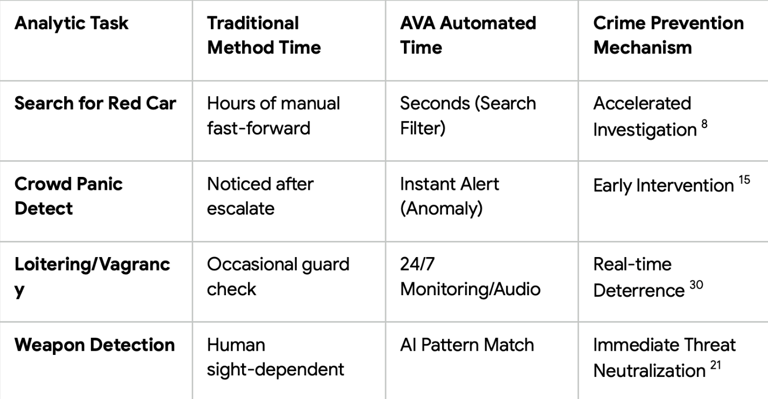
Advanced video analytics encompass a suite of software enhancements including, but not limited to, facial recognition technology (FRT), automatic license plate recognition (ALPR), behavioral anomaly detection, and gunshot detection technology (GDT).3 These technologies transform raw video into real-time alarms and security measures, along with structured, searchable data, allowing law enforcement and security personnel to bypass the cognitive overload and fatigue associated with manual monitoring.8 Real-world evidence suggests that while traditional CCTV yields a modest 16% reduction in overall crime (largely driven by car park settings) the introduction of analytical layers can catalyze reductions of up to 30% to 40% in high-density urban environments.1
Comparative Performance Metrics: Traditional CCTV vs. AVA
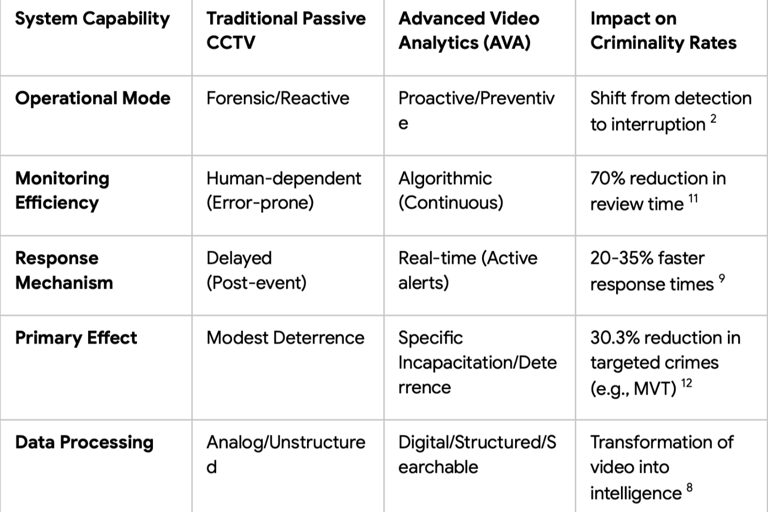
Meta-Analytic Foundations and the Impact of Active Monitoring
The scholarly consensus on surveillance effectiveness has been influenced by a 40-year systematic review and meta-analysis conducted by Piza, Welsh, Farrington, and Thomas (2019). This review, synthesizing decades of evaluative research, established that CCTV is associated with a significant and modest decrease in crime.1 Crucially, the analysis generated evidence that CCTV schemes incorporating active monitoring generated larger effect sizes than passive systems.1 This finding remarks the necessity of a "guardian" that is present and attentive.
The largest and most consistent effects observed in these meta-analyses were localized in parking facilities, where CCTV contributed to a 51% reduction in crime.1 However, when advanced video analytics are deployed in more complex settings, such as residential areas and public transit, the efficacy of the system becomes dependant on its ability to filter "normal" behavior from "anomalous" threats.15 In residential areas, a proper implementation of analytical surveillance is linked to a 12% reduction in crime compared to control areas.2
Efficacy Variation by Setting and Analytic Layer
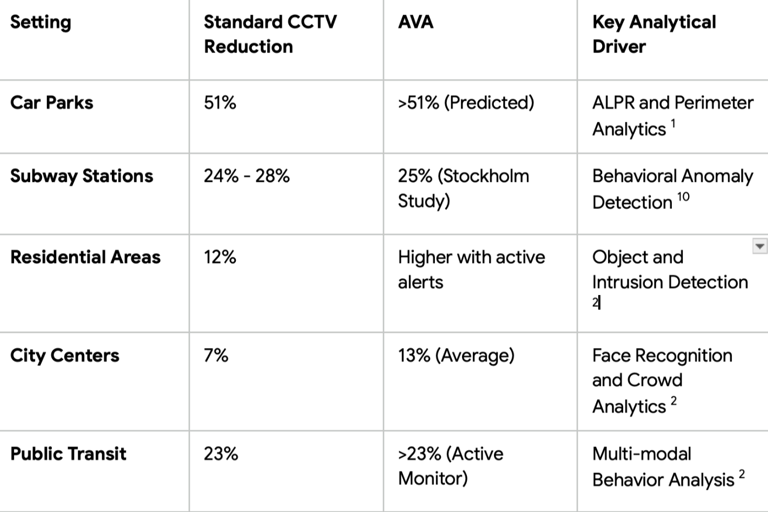
The variance in these figures suggests that advanced video analytics are not a monolithic solution but must be tailored to the environmental constraints of the target area. In city centers, where the high volume of foot traffic renders passive surveillance ineffective, AI-driven crowd management and facial recognition are essential for maintaining a "deterrence gradient".11
The Milwaukee Experiment: Evaluating Integrated ALPR and GDT
A critical study in the evaluation of advanced analytics was conducted on the Milwaukee Police Department's (MPD) public surveillance network. This intervention involved the integration of two specific analytic technologies: Automatic License Plate Recognition (ALPR) and Gunshot Detection Technology (GDT) along with high resolution PTZ cameras.6 The objective was to move from a general surveillance model to a data-driven, optimized network.
The results of the Milwaukee study provide a nuanced view of "before and after" criminality. When analyzing the intersections where these technologies were installed, the initial models found an increase in some criminal events.19 This phenomenon is frequently cited in criminology as "detection bias", where the installation of better equipment allows law enforcements to record crimes that were previously missed.19 Despite this statistical artifact, the investigative utility of the system was vastly improved.
Milwaukee Intervention Statistics: Center Street and Muskego Way
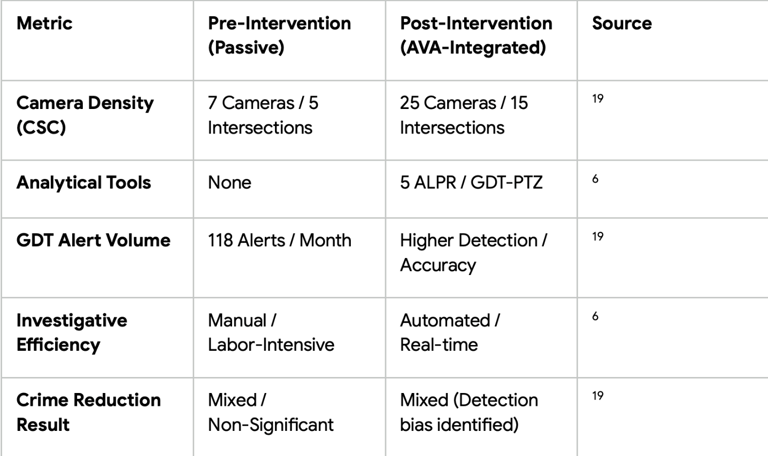
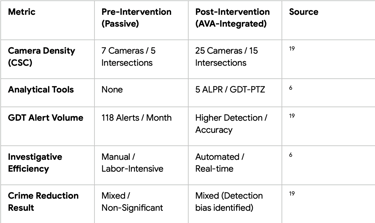
The Milwaukee evaluation highlighted significant implementation challenges. Software delays between the GDT alert and the camera response meant that by the time a PTZ camera zoomed in, suspects had often fled the scene.6 Furthermore, ALPR alert overload led to "operational friction", forcing staff to pause high-priority tasks to acknowledge non important hits.6 These findings indicate that while advanced analytics improve the capacity for crime detection, they do not automatically reduce crime rates unless operational workflows are streamlined.
Biometric Surveillance and Specific Deterrence: The Chicago FRT Study
One of the most compelling pieces of evidence for the effectiveness of advanced analytics comes from a quantitative analysis of facial recognition technology (FRT) in Chicago. In 2013, the Chicago Police Department (CPD) implemented DataWorks Plus software to enhance their existing camera network. A thesis by Gao (2021) utilized a Difference-in-Differences (DiD) methodology to compare Chicago's crime rates with Milwaukee's, isolating the effect of the FRT implementation.12
The study found a highly statistically significant negative correlation between motor vehicle theft (MVT) and the use of facial recognition technology. Specifically, Chicago experienced an average decrease of 30.3% in motor vehicle thefts annually following the implementation.12 In contrast, no significant correlation was found for violent crimes like homicide or robbery, suggesting that advanced analytics function most effectively as a deterrent for property-related crimes where the offender is aware of the surveillance and chooses a rational path to avoid detection.12
Chicago Difference-in-Differences Analysis (FRT Implementation)
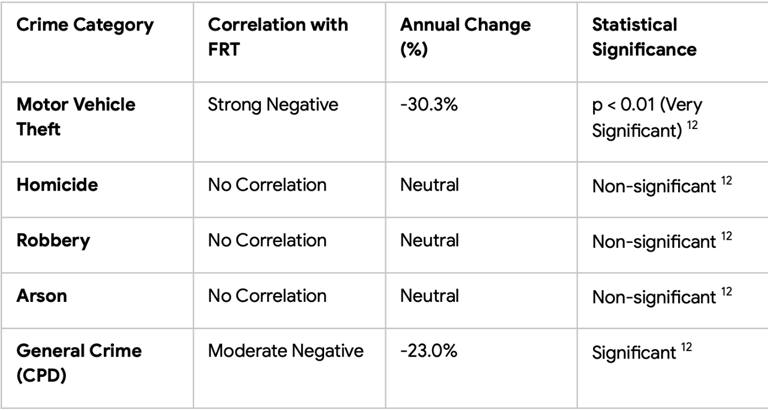
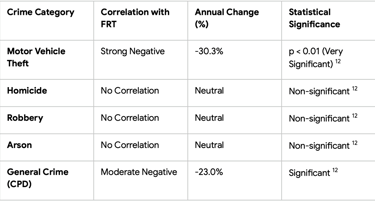
The mechanism behind this reduction is theorized to be "specific deterrence." Unlike general violent crimes, which are often impulsive, motor vehicle theft is frequently a public and visible act. The realization that an FRT-enabled system can map a face to a criminal record in real-time alters the offender's "perceived risk of apprehension". The GAO (2021) study suggests that the impact on vehicle theft is plausible because of the higher likelihood of repeat offenders in this category, whose identities are already stored in police databases.12
High-Density Urban Success: The Singapore and Dubai Benchmarks
Singapore's Smart Nation initiative represents the global standard for integrated advanced video analytics. By 2018, the city-state had fully integrated AI-enabled tools with its existing CCTV infrastructure to create a "smart city" ecosystem.3 These systems utilize a hybrid architecture of real-time facial recognition, anomaly detection, and predictive policing to maintain urban safety.
In Singapore’s Orchard Road district, the deployment of advanced surveillance in 2019 resulted in a 27% drop in thefts.18 Furthermore, in retail sectors, the use of 360-degree cameras and high-resolution facial recognition led to a 62% reduction in shoplifting.11 The effectiveness of these systems is often attributed to the "deterrence gradient".11
Singapore Smart Nation Impact Statistics
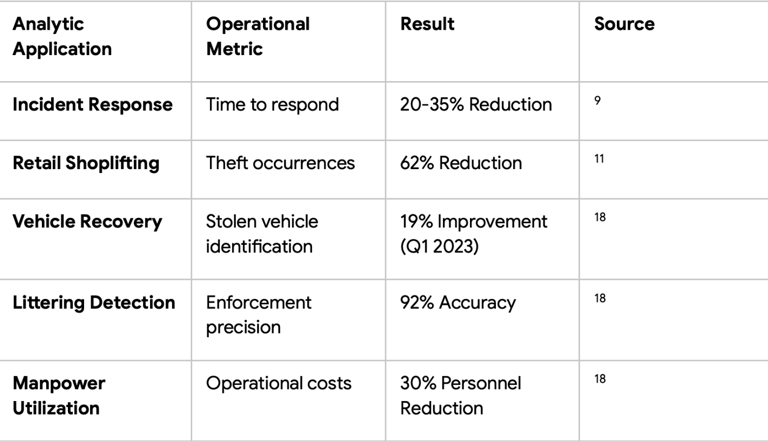
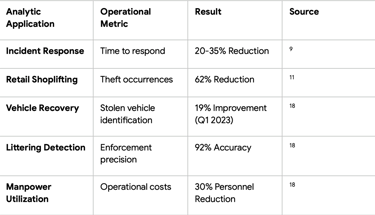
The Singapore model demonstrates that advanced video analytics serve as a "force multiplier". By automating the monitoring of 12,000 cameras (in the case of littering detection), the system allows for the efficient direction of enforcement officers, reducing the need for constant human patrols.18 This operational efficiency is a secondary, but vital, component of crime reduction, as it ensures that the "certainty of punishment" is backed by the physical presence of responders.
Accuracy and Performance of Deep Learning Models in Surveillance
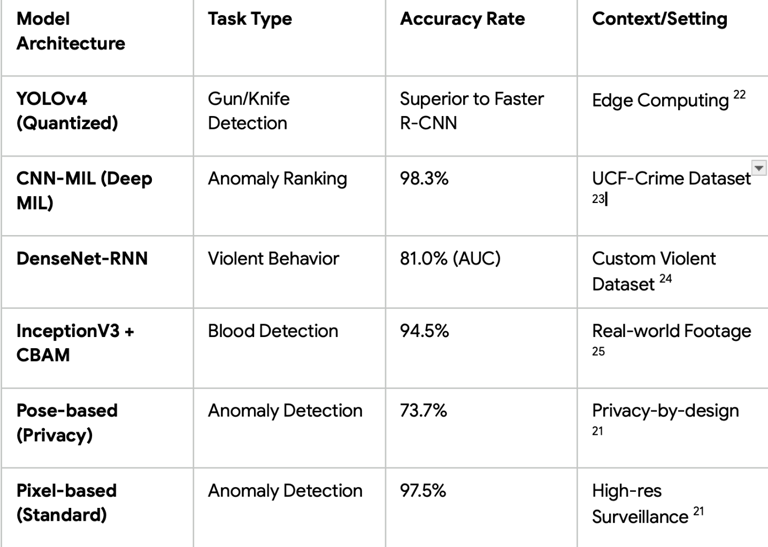
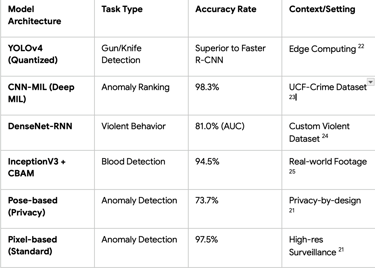
The technical data reveals a critical trade-off between privacy and precision. When systems are designed to be "privacy-preserving" (using pose-based tracking instead of pixel analysis), accuracy drops by about 24%.21 This suggests that the most effective criminality-reducing systems are those that maintain high-resolution pixel data, which in turn necessitates robust legal and ethical frameworks to govern their use.9
Behavioral Anomaly Detection and Video Anomaly Detection (VAD)
A significant advancement in video analytics is the transition from simple motion sensors to "Video Anomaly Detection" (VAD). VAD systems learn a "normality model" from existing footage and flag any deviation like fighting, road accidents, or illegal parking as an anomaly.16 This is particularly relevant in crowded environments where traditional tracking fails due to occlusions.28
Supervised methods for anomaly detection, tested on the UCF-Crime dataset, have shown accuracy rates of 92.4% across five classes of crime (fighting, burglary, arson, etc.).16 These systems allow for a "coarse-level video understanding," filtering out the vast majority of normal activity so that security personnel can focus on high-risk events.27 This "attention-based" approach is what distinguishes advanced video analytics from the passive monitors of the previous generation.
Behavioral Analysis and Operational Gains
Atlantic City ALPR Expansion: A Study of Gun Violence
Automated License Plate Readers (ALPR) have evolved from simple toll-collection tools to sophisticated investigative assets. In Atlantic City, the expansion of ALPR technology in late 2022 provided a platform for a longitudinal study of its impact on gun violence and property crime. Using interrupted time-series (ARIMA) analysis, researchers measured changes in mean monthly crime counts.32
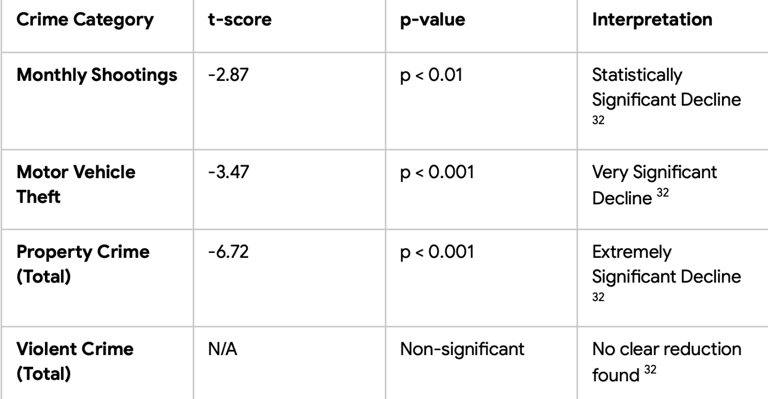
The findings were statistically significant for several high-priority crime categories. Monthly shootings, motor vehicle thefts, and overall property crimes all saw substantial declines following the expansion of the ALPR network.32
Atlantic City ARIMA Time-Series Results (Post-Expansion)
The mechanisms at work in Atlantic City point toward both a deterrent effect and an incapacitation effect. Detectives from the Violent Crimes Unit utilized the ALPR system in 75% of shooting investigations post-expansion, compared to 57.8% previously.32 The ability to rapidly identify vehicles entering or leaving a shooting scene provides law enforcement with a "tangible evidentiary lead" that increases the clearance rate and the likelihood of arresting high-frequency offenders.
Atlantic City ALPR Expansion: A Study of Gun Violence
The integration of advanced video analytics necessitates a re-evaluation of core criminological theories. The Rational Choice Theory (RCT) suggests that offenders perform a cost-benefit analysis before committing a crime.1 Advanced analytics significantly increase the "perceived cost" by removing the anonymity previously afforded by poor-quality CCTV or unmonitored areas.11
Furthermore, the "Routine Activity Theory" identifies the need for a "capable guardian" to prevent crime. Advanced analytics serve as an "autonomous guardian" that does not suffer from the fatigue that reduces human monitoring efficiency after just 20 minutes.9 This continuous guardianship ensures that the "opportunity" for crime is reduced across both space and time.3
Deterrence and Displacements: The Paradox of Active Analytics
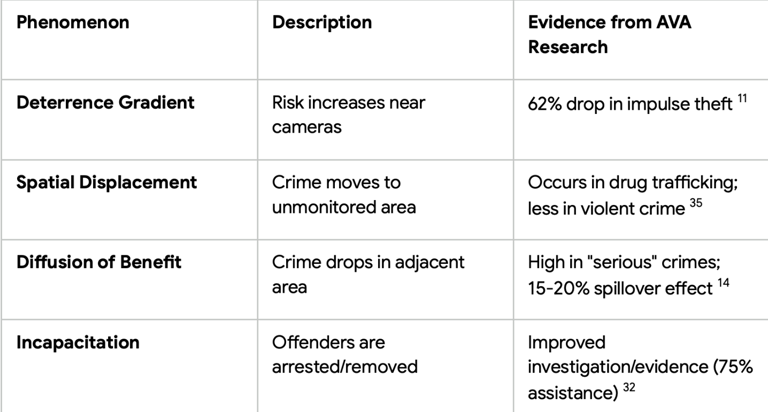
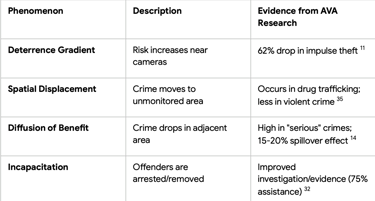
A common critique of surveillance is that it merely "displaces" crime. However, the 40-year systematic review found that displacement was detected only infrequently and was not uniform across offence types.36 In many cases, the "diffusion of benefit" outweighed the displacement effect, as offenders were unable to determine the exact boundaries of the system’s analytical capabilities.14
The "Tampa Failure" and the Limitations of Early Smart CCTV
It is essential to acknowledge that not all implementations of advanced analytics have been successful. The "Tampa Smart CCTV Experiment" in 2003 involved the integration of facial recognition technology (FRT) called FaceIt into a 36-camera system in Ybor City.38 After a two-year trial, the police department abandoned the system, citing its failure to identify a single wanted individual.38
This failure illustrates that the effectiveness of advanced video analytics is not solely a technical issue but an operational and cultural one. The Tampa experiment suffered from technical limitations of early 2000s biometrics, but it also became a site of struggle over the limits of police power.38 Modern systems, which have achieved 99.3% accuracy in controlled environments, have largely overcome the technical hurdles of the Tampa era, yet the lessons regarding "implementation fidelity" remain relevant.11
Socio-Legal Considerations and the Future of Analytical Surveillance
As AI-enabled surveillance becomes more pervasive, the focus of research is shifting toward ethical implications, including algorithmic bias and the "authoritarian drift" associated with unregulated monitoring.9 Facial recognition systems have been documented to have error rates up to 35% higher for darker-skinned females, which could lead to wrongful identifications and eroded trust in law enforcement.9
Furthermore, some evidence suggests that while advanced analytics reduce certain crimes (e.g., motor vehicle theft), they do not address the "root causes" of social issues.18 The "techno-solutionist" approach, which relies on technology to solve safety issues, may overlook the broader social implications of constant monitoring.7
Strategic Recommendations for High-Performance Implementation
Narrow Targeting: Systems should be narrowly targeted on vehicle and property crimes where advanced analytics (ALPR/FRT) show the highest efficacy.1
Active Integration: AVA should not be a stand-alone measure but must be integrated with real-time response protocols (e.g., Singapore’s "Safety Islands").7
Accuracy Maintenance: To avoid the "Tampa Failure," agencies must ensure high-resolution cameras (at least 3K/5MP) to provide the necessary clarity for AI processing.11
Privacy-by-Design: Implementations should include automated face-blurring for bystanders and 30-day data retention limits to maintain public legitimacy.11
Operational Awareness: Police personnel must be trained and aware of the technology’s existence and how to access its data to prevent the "Milwaukee communication gap".6
Conclusion: The Quantitative Reality of Advanced Video Analytics
The empirical record demonstrates that advanced video analytics, when implemented with high fidelity and operational integration, provide a statistically significant reduction in criminality. From the 30.3% reduction in Chicago vehicle thefts to the 62% drop in Singaporean retail theft and the significant declines in Atlantic City shootings, the evidence favors the "active monitoring" model.12 While standard CCTV provides a modest 16% reduction, the addition of an "algorithmic brain" allows for the proactive interruption of criminal acts and the rapid identification of repeat offenders.
The future of urban safety lies in the transition from "watching" to "interpreting." As deep learning models continue to improve in accuracy and edge computing reduces latency, the ability of advanced video analytics to serve as a ubiquitous "autonomous guardian" will only grow. However, the effectiveness of these systems will remain contingent on their ability to balance high-precision detection with ethical governance and human oversight, ensuring that the "Smart City" remains a safe and democratic space for all citizens.
References
CCTV surveillance for crime prevention. A 40-year systematic review with meta-analysis - CUNY Academic Works, accessed April 16, 2026, https://academicworks.cuny.edu/cgi/viewcontent.cgi?article=1275&context=jj_pubs
What Is Proactive Video Monitoring? — Pye-Barker Fire & Safety, accessed April 16, 2026, https://pyebarkerfs.com/proactive-video-monitoring-preventing-crime-before-it-happens/
SMART CCTVS FOR SECURE CITIES: POTENTIALS AND CHALLENGES - CSS ETH Zürich, accessed April 16, 2026, https://css.ethz.ch/content/dam/ethz/special-interest/gess/cis/center-for-securities-studies/resources/docs/RSIS-Smart%20CCTVs%20for%20Secure%20Cities,%20Potential%20and%20Challenges.pdf
Live CCTV Monitoring as a Crime Prevention Method: A Case Study of Prayer Rooms at Station X and Z, accessed April 16, 2026, https://scholarhub.ui.ac.id/cgi/viewcontent.cgi?article=1007&context=kriminologi
Literature Review of Deep-Learning-Based Detection of Violence in Video - PMC - NIH, accessed April 16, 2026, https://pmc.ncbi.nlm.nih.gov/articles/PMC11207446/
Lessons Learned Implementing Video Analytics in a ... - Urban Institute, accessed April 16, 2026, https://www.urban.org/sites/default/files/publication/101647/lessons_learned_implementing_video_analytics_in_a_public_surveillance_network.pdf
Safety in the Techno-Mediated City: Insights from Bengaluru's AI ..., accessed April 16, 2026, https://www.tandfonline.com/doi/full/10.1080/10630732.2025.2583882
How video analytics enhance law enforcement performance - Milestone Systems, accessed April 16, 2026, https://www.milestonesys.com/resources/content/articles/video-analytics-law-enforcement/
INTERNATIONAL JOURNAL OF - ijmrset, accessed April 16, 2026, https://www.ijmrset.com/upload/79_Deployment%20of%20AI-Enabled%20Surveillance%20Systems%20in%20Urban%20Areas%20for%20Strengthening%20Public%20Safety.pdf
The role of Video Surveillance for Crime Reduction | Blog - Aipix, accessed April 16, 2026, https://aipix.ai/blog/en/the-role-of-video-surveillance-in-enhancing-public-safety-research-based-on-40-years-of-surveys-and-case-studies/
Should CCTV cameras be placed in public places? Analysis, accessed April 16, 2026, https://cctvmaintenance.com.sg/should-cctv-cameras-be-placed-in-public-places/
A Quantitative Analysis on Impact of Facial Recognition Technology ..., accessed April 16, 2026, https://knowledge.uchicago.edu/record/3875
CCTV Surveillance for Crime Prevention: A 40-Year Systematic ..., accessed April 16, 2026, https://www.ojp.gov/library/publications/cctv-surveillance-crime-prevention-40-year-systematic-review-meta-analysis
Surveillance cameras and crime: a review of randomized and natural experiments, accessed April 16, 2026, https://www.scup.com/doi/10.1080/14043858.2017.1387410
NEC Enhanced Video Analytics Provides Advanced Solutions for Video Analytics, accessed April 16, 2026, https://www.nec.com/en/global/techrep/journal/g18/n02/180209.html
Human-Centric Anomaly Detection in Surveillance Videos Using YOLO-World and Spatio-Temporal Deep Learning - arXiv, accessed April 16, 2026, https://arxiv.org/html/2510.22056v1
License Plate Recognition: What is ALPR & LPR Technology? - Pelco, accessed April 16, 2026, https://www.pelco.com/blog/license-plate-recognition
Should CCTV cameras be placed in public places? Analysis, accessed April 16, 2026, https://wenhong.com.sg/should-cctv-cameras-be-placed-in-public-places-analysis/
Optimizing the Use of Video Technology to Improve Criminal Justice ..., accessed April 16, 2026, https://www.ojp.gov/pdffiles1/nij/grants/308635.pdf
Exploring the Integration of Deep Learning in CCTV Systems for Enhanced Security Measures in Academic Libraries - ResearchGate, accessed April 16, 2026, https://www.researchgate.net/publication/388820328_Exploring_the_Integration_of_Deep_Learning_in_CCTV_Systems_for_Enhanced_Security_Measures_in_Academic_Libraries
AI-Powered Video Analytics: Enhancing Real-Time Threat Detection ..., accessed April 16, 2026, https://www.researchgate.net/publication/394519577_AI-Powered_Video_Analytics_Enhancing_Real-Time_Threat_Detection_and_Public_Safety
(PDF) Leveraging Real-time Edge AI-Video Analytics to Detect and Prevent Threats in Sensitive Environments - ResearchGate, accessed April 16, 2026, https://www.researchgate.net/publication/374532516_Leveraging_Real-time_Edge_AI-Video_Analytics_to_Detect_and_Prevent_Threats_in_Sensitive_Environments
(PDF) Enhancing video surveillance for crime detection using anomaly detection techniques, accessed April 16, 2026, https://www.researchgate.net/publication/389733145_Enhancing_video_surveillance_for_crime_detection_using_anomaly_detection_techniques
AI-Based Detection of Unwanted Behavior: The Paradoxical Effect of Standard Data Augmentation in Video Surveillance | OpenReview, accessed April 16, 2026, https://openreview.net/forum?id=mrOCZFTRow
Real time blood detection in CCTV surveillance using attention enhanced InceptionV3, accessed April 16, 2026, https://pmc.ncbi.nlm.nih.gov/articles/PMC12331963/
artificial intelligence and the anti-authoritarian fourth amendment - Penn Carey Law Legal Scholarship Repository, accessed April 16, 2026, https://scholarship.law.upenn.edu/cgi/viewcontent.cgi?article=1904&context=jcl
Real-world Anomaly Detection in Surveillance Videos - Center for Research in Computer Vision, accessed April 16, 2026, https://www.crcv.ucf.edu/projects/real-world/
CamNuvem: A Robbery Dataset for Video Anomaly Detection - PMC, accessed April 16, 2026, https://pmc.ncbi.nlm.nih.gov/articles/PMC9784719/
Big data analytics of crime prevention and control based on image processing upon cloud computing - OAE Publishing Inc., accessed April 16, 2026, https://www.oaepublish.com/articles/jsss.2020.04
Real-Time Video Surveillance for Faster Threat Detection - Omnilert, accessed April 16, 2026, https://www.omnilert.com/blog/real-time-video-surveillance
How to Keep Homeless Away From Business Safely in 2026, accessed April 16, 2026, https://getsafeandsound.com/blog/how-to-remove-homeless-from-commercial-property/
An Evaluation of a Major Expansion in Automated License Plate ..., accessed April 16, 2026, https://www.tandfonline.com/doi/full/10.1080/24751979.2025.2473363
Understanding the effectiveness of CCTV: Displacement, Deterrence and Detection - Sevenoaks, accessed April 16, 2026, https://cds.sevenoaks.gov.uk/documents/s44763/08%20Appendix%206%20-%20Dr.%20Taylors%20Report.pdf?J=1
In Detail: Automated License Plate Readers (ALPR) [May 2024], accessed April 16, 2026, https://justiceresearch.dspacedirect.org/bitstreams/ac003947-ea7c-4962-beb2-19bdf4ee4b1f/download
Impact of CCTV surveillance on Crime - CCJR - Center for Criminal Justice Research, accessed April 16, 2026, https://ccjr.cse.iitk.ac.in/opapers/Impact%20of%20CCTVs%20on%20Crime.pdf
Does CCTV displace crime? | Request PDF - ResearchGate, accessed April 16, 2026, https://www.researchgate.net/publication/249786322_Does_CCTV_displace_crime
'Cycle Thieves, We Are Watching You': Impact of a Simple Signage Intervention against Bicycle Theft | PLOS One, accessed April 16, 2026, https://journals.plos.org/plosone/article?id=10.1371/journal.pone.0051738
(PDF) The Tampa “Smart CCTV” Experiment - ResearchGate, accessed April 16, 2026, https://www.researchgate.net/publication/45183078_The_Tampa_Smart_CCTV_Experiment
Artificial Intelligence and Crime Detection: A Critical Review - ResearchGate, accessed April 16, 2026, https://www.researchgate.net/publication/395788481_Artificial_Intelligence_and_Crime_Detection_A_Critical_Review
Facing the Facts: The Efficacy of Police Facial Recognition Technology - Department of Economics, accessed April 16, 2026, https://economics.virginia.edu/sites/economics.as.virginia.edu/files/2025-05/Taliaferro%2C%20Davis.pdf
CITRIS Report: The San Francisco Community Safety Camera Program - An Evaluation of the Effectiveness of San Francisco's Community Safety Cameras | Request PDF - ResearchGate, accessed April 16, 2026, https://www.researchgate.net/publication/255857323_CITRIS_Report_The_San_Francisco_Community_Safety_Camera_Program_-_An_Evaluation_of_the_Effectiveness_of_San_Francisco's_Community_Safety_Cameras
3K Security Cameras | 5MP & 6MP High Resolution | CCTV Guru, accessed April 16, 2026, https://cctvguru.com.au/collections/3k-security-cameras